Showing posts with label Bikes. Show all posts

Thursday, November 11, 2010

Harley Davidson:Rocker C Review.


The Rocker or the Rocker C is the Custom Chopper created for the person that has cast a glancing view to the custom or chopper motorcycles that have populated the scene a few years back. The problem with some of the past customs or choppers was the price and reliability. Some of the custom designed parts, chopped frames and extended forks gave the creations a terrific profile, but, often times created riding and dependability problems. This is not to say that all customs and choppers had a problem, but there were some with problems and of course resale was always a concern for these special creations.


Now Harley has a factory custom chopper that has a lot of the upgrades without the extremes often associated with some of the creations of the past. Plus, it was engineered and designed for reliability and ride ability that very few people can create without the deep pockets of someone like Harley-Davidson. Now, with the Rocker, you can have your chopper profile, dependability and service ability with a huge selection of off the shelf performance and chrome upgrades.


What makes this a Harley is the Softail frame with a rigid mounted Electronic Sequential Port Fuel Injection 96B twin Cam, 6 Speed power plant. And of course all of the hand controls are the same throughout the line as for brake pedals and hand controls. It has a speedometer, no tach, with the turn signal and neutral indicators in a little display on the fuel tank.


What sets this beast apart from the standard line is the extended front forks and large 240 mm rear tire. The wheelbase of this custom is only about 5 inches longer (69.2 inches) than the standard Softail. Besides the chopper profile, they enhanced the custom look with a rear fender that hugs the oversized rear tire with custom wheels by mounting it to the swing arm and finished it with a nice color keyed frame.

On the Rocker C, if you haven’t noticed, they have what appears to be a solo design. But, should you get lucky, there is a passenger seat that is conveniently hidden under the solo seat. It appears to be a little torture pad. But should you need it, it could be your friend. Just a quick note about the seat; I rode the Rocker with it hidden under the seat and with it in place. Now for vanity reasons, you would want the hard solo look for bar hopping, but should you venture out on the road, with the seat in place, it actually gives a little lower back support for more comfort.

As you can see in the picture there is a stage one upgrade. This included new exhaust pipes and dyno tuned remapping. I recommend this upgrade for all Harleys, with the exception of the V-rod, for performance reasons. Pictured are the Vance and Hines Big Radius 2 into 2 Black pipes that sell for $799.22. This is a great upgrade.


I have ridden choppers in the past and never really like the ride. It was a full time job to manage that 300 rear tire over uneven pavement and speed bumps and the turning radius was poor when you turn around or when maneuvering around in a parking lot. Climbing on the Rocker the first thing that I noticed was the nice low seat. Your feet are flat on the ground and with your legs bent, you have the feeling that you are wearing the bike rather than just sitting in it. After grabbing the slightly curved back handlebars on risers, I noticed that they had internal wiring. That gave it a very nice clean look. But not to be distracted with the great look of this new toy, I wanted to find out if this machine really rides like any of the Harley’s that I have ever been on.

Surprisingly, after getting out of the parking lot, I noticed very little difference from most of the softails that I have been on in the past. The upgraded Vance and Hines pipes sounded great and low end torque increase from the stock Softail was noticeable. The steering was light and easy. It was nothing like some of the choppers from the past.

The Twin Cam B power plant is very smooth, even with setting at idle stopped. After negotiating some nice long curves on the back roads, you notice that you lean a little more then on some of the shorter wheel base machines. Then with a slight twist of the grip, the extra low-end torque really felt good powering out of corners. This is a very easy to ride custom. Just to see if there were any problems with turning, I slowed to a crawl and made a u-turn on a two lane, it was a piece of cake.

After finding an on-ramp to the local freeway, I was able to find the throttle limit and was pleasantly surprised at the power. Straight as a rocket, you could easily find a three digit number by the time you have to merge with traffic. Then of course, you have to grab a little brake to blend into with all of the cages. On the freeway, it rides like a dream. With the sixth gear, you can idle down the road with ease and you always have plenty of power.

I rode this Rocker on curvy roads to interstate riding and, at all times, found that this little Rocker was a champ and a pleasure to ride. It is obviously not a cruiser, nor is it a Buell, but you could spend the day on the bike and feel great at days end. What really sets this ride apart is the styling. Even with the exotic styling, for a Harley, it is a very tame ride when compared to the old style hardtail choppers. It is a ride that you want to be seen on.

Wednesday, November 10, 2010

Radial Engine Motorcycle.


The radial engine is a thing of beauty and it looks like several other folks think the same thing. After I posted the radial motorcycle yesterday, I contacted Rotec Engineering, makers of these 7 cylinder radial engines, and according to them, there are at least 4 of these projects in various stages of completion at the present time. Yesterday's bike and this one as well seem to be a bit short of running. I see no provisions for exhaust yet and no front brakes. This bike has no handlebars either so we're still in the building stage. At first glance, you wonder if these guys are serious but these do seem to be real works in progress.


Additional closeup photos on yesterday's post show exhaust pipes behind the engine and at least a foot brake pedal so it may be running as is.

This longitudinal engine arrangement seems more natural for a motorcycle, better clearance for cornering, however, cooling the rear cylinders would definitely be a problem. Yesterday's transverse arrangement is great for cooling and correct for the engine's design but it presents clearance problems, not only straight up for the bottom cylinder but when leaned in either direction, as well.


 I can't believe these bikes will be much more than showpieces when done, who could actually ride them? Still, I think radial engines are among the best looking engines ever designed and these Rotecs are small enough to put in all sorts of different things, airplanes look great with a big radial out front but there are always cars, trucks, boats, you name it. But you have to give these guys credit, a radial engined motorcycle, superb!


Sunday, August 15, 2010

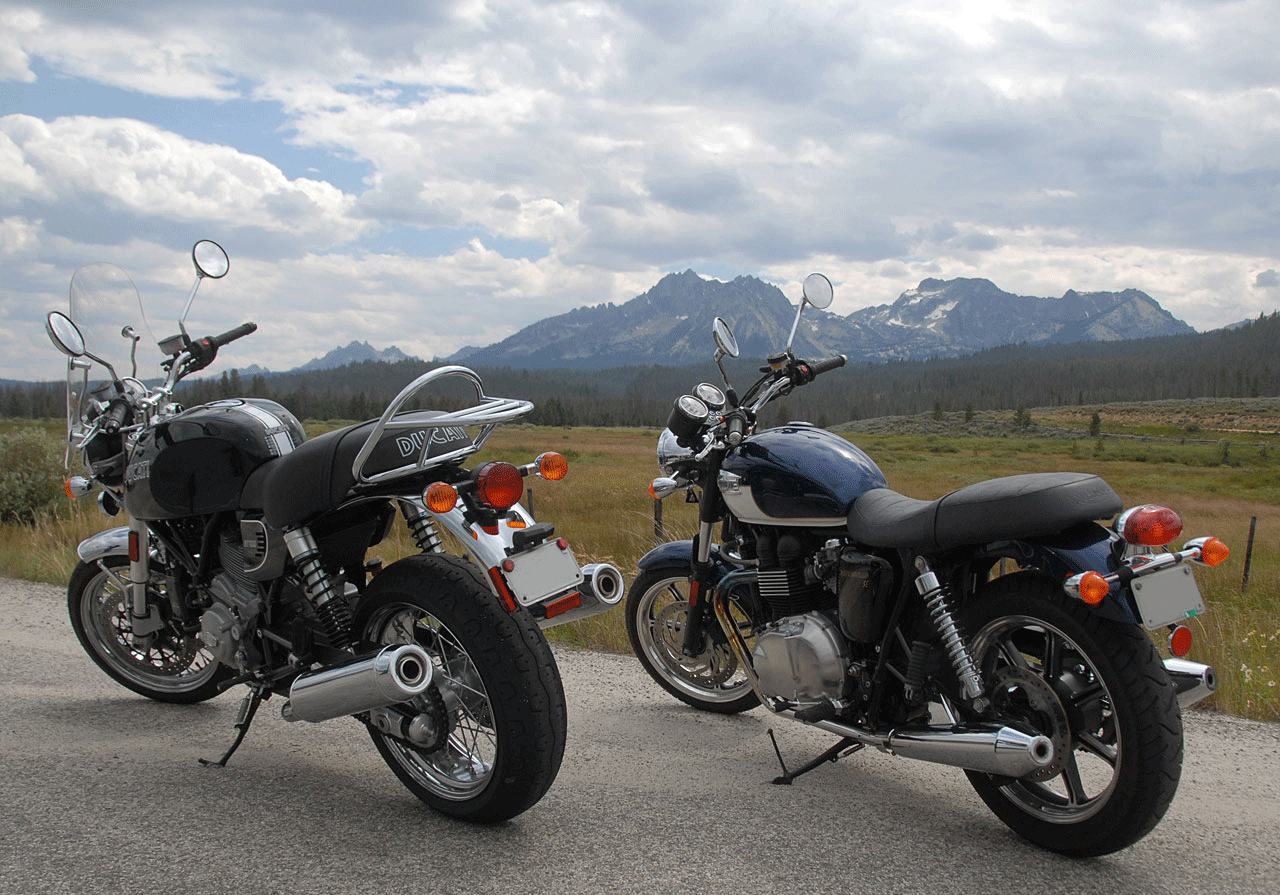
Triumph Bonneville SE and Ducati GT 1000 touring.

Triumph Bonneville SE and Ducati GT 1000 touring.
The Bonneville moniker first affixed itself to Triumph’s 650cc Parallel Twin-powered T120 in 1959, a high-performance ride through the ‘60s that earned its classy moniker as a tribute to the land speed racing exploits of the British marque during the 1950s. A second Bonneville incarnation, dubbed the T140, upped displacement to 750cc but ended production with Triumph’s decline and near obliteration in the early ‘80s. The Bloor restoration of the historic English marque saw the Bonneville’s return in 2001, where it has since anchored the company’s Modern Classics.

Triumph expanded the Bonneville line by two additional models, with an all-new base model and SE version. The two join the long-standing Bonneville T100, which continues in the Modern Classic line, relegating its spot as the flagship to the new Bonneville. The new Bonnie varies from its T100 with smaller ergos and wheels, the hoops being two inches smaller and cast instead of wire-spoked. As for the difference between the base Bonneville and the SE, it’s cosmetic, with the SE sporting a tank badge, aluminum engine cases and a two-tone paint scheme with pinstripe, as well as the inclusion of a useful tachometer on the instrument console. All three Bonnevilles, as well as the entire 2009 Modern Classic Twins, are fuel injected for the first time to meet US emissions.

Right out of the box, the Bonneville struck an authentic chord in the looks department. The Bonneville SE we tested generated, by far, the most awestruck praise from roadside gawkers – quite a compliment considering Ducati’s undoubted skill at producing sexy bikes. And this was in spite of the SE’s lack of wire-spoked wheels, which is such a huge part of the vintage look. Were I to purchase a Bonneville, I’d have to tap the wire-spoked T100 for this very reason alone. The Trumpet scores a big win over the Duc in the very subjective styling comparison.

As for the motor, the Triumph’s 865cc Parallel Twin doesn’t measure up to the Ducati, down 127cc to it competitor. Engine performance expectations have dramatically inflated since the Bonnie’s debut 50 years ago. The modern Twin cranks 58 horsepower at the rear wheel and 44 lb-ft torque. It doesn’t take long at the controls to realize the Bonneville motor is tuned for a more leisurely riding approach - much different than the Ducati’s rip-snorting L-Twin.

Yet the Triumph Twin delivers enough pep to motor up to triple digits and is spunky in its 4000 rpm sweet spot. The old riding bromide about riding a slow bike fast rings true on the Bonneville – a rider with moderate skills will be pushing the Twin to its limit. There’s a certain thrill in that

Seamless power delivery and user-friendly throttle feel highlight the Twin’s traits. Considering it’s the first year of fuel-injection for the Modern Classics, Triumph nailed it first time around. The two-stage choke, unlike the carbs, is real and needed on cold starts. As for those façade carbs, explaining them to curious onlookers is an amusing novelty at parking lots and gas stations – particularly to riders who claimed they could tell the Bonnie was carbureted by its sound or smell…

Smooth and easy, a rider can’t get lost in the Triumph’s 5-speed gearbox. Teamed with one of the lightest clutch lever pulls we’ve sampled, the transmission lends itself well to entry-level riders who won’t be missing shifts or fumbling with neutral at stop lights.

One disc down up front compared to the dual-disc Ducati, the Triumph brakes without drama via a single 310mm rotor up front. Head to head, the Duc’s dual Brembo calipers deliver superior feel, but Triumph’s Nissin 2-piston caliper binders make confident, controlled stops. While the lever is stiffer on the Triumph, there weren’t any helter skelter moments for us under hard braking.

After the motor, handling performance is where the Triumph loses the most ground on the Ducati. Its softer 41mm Kayaba fork hinders high-speed maneuvering, and while the dual rear shocks (also Kayaba) are pre-load adjustable, railing in tight terrain overtaxes both the suspension units. That said, the Bonneville handles sharp at lower speeds with its low center of gravity, and is one of the easiest-to-ride shifting motorbikes we’ve ever sampled.

The Bonneville ergonomics fit smaller-statured riders well, Triumph lowering the seat height to 29.5 inches and repositioning the bars down and toward the rider. While it didn’t gel as well with my 6’1” frame (probably anyone approaching 5’10” will be too big) the riding position is upright, standard and comfortable, except for one big, huge, gigantic, stupendous caveat (brace yourself, a seat diatribe on its way…).

Short distance jaunts on the Bonnie are fine, but we started getting uncomfortable after about 100 miles, perturbed at 150, and delirious about the 200-mile mark in the Triumph’s excruciating saddle. The new Bonneville’s seat height is lower, in part, because they sculpted some foam out. Bad idea! I wondered how the SE’s seat would hold up on long distance rides during our brief sub-100-mile test ride at the official press launch in New Orleans. Now I know, and my tookus still whines, “remember that day you rode 250 miles on the Bonneville SE? Man, I will never forgive your ass for that!”

Admitting that… The two-inch lower seat height, along with a narrower tank, makes the Bonneville feel way smaller than the Ducati, even though at 497 lbs (472 lbs tank empty) it is actually a full 31 lbs heavier. The small dimensions make mincemeat out of those tricky low-speed maneuvers that really jump out and bite beginners.

The Bonneville and GT recorded almost identical fuel efficiency – the Triumph edging out a 48.6 to 47.3 mpg advantage. The Bonneville has a slightly bigger fuel tank too, 4.2 gal to 3.9 gal, with a theoretical range near 200 miles. The strange thing is the Bonneville always seemed to want gas first during our 750-mile test ride with the low fuel light constantly coming on (the Speed Triple registered a similar complaint during our 2007 street fighter test). Not a mystery is which bike is easier to fill, with the Bonneville splashing gas out on more than one occasion and the fuel cap fully detaching from the bike (easy to misplace for scatter brained test riders…).

Solid fit and finish round out an attractive, if Spartan, instrument package. The SE’s analog right-side tach teams well with the left-side speedo (the standard Bonneville not offering a tach). A fuel gauge would be appreciated, though there’s no real room for one, just a couple idiot lights and neutral, high-beam and turn signal indicator lights.

The Bonneville delivers a lot of bang for the buck. At $8399 for the SE and $7699 for the standard Bonneville, it’s 30-35% less expensive than the Ducati! I have to admit, however, that I’d spring the extra $400 for the $8799 T100 for the wire-spoked wheels alone. (The T100, which is unchanged for 2009 except for being fuel injected, is a much better fit ergonomically for larger riders as well.)

In short, the Bonneville SE is not a bad machine by any means. Power delivery won’t overwhelm newbies but still gets the Trumpet up to respectable cruising speeds. It’s a fun ride and an ideal bike for smaller riders. Faced against the Ducati, however, we imagine if it could talk, even the polite British Twin would acquiesce it does not compare with its sportier Italian rival. The Bonnie still keeps a stiff upper lip, however, secure in its role as an ideal starter bike or sharp-looking play bike for the casual weekend enthusiast.